
How Faster Customer Response Times Drive Revenue Growth
Learn why customer response speed directly impacts sales, retention, and customer satisfaction, and how growing businesses can improve response times at scale.
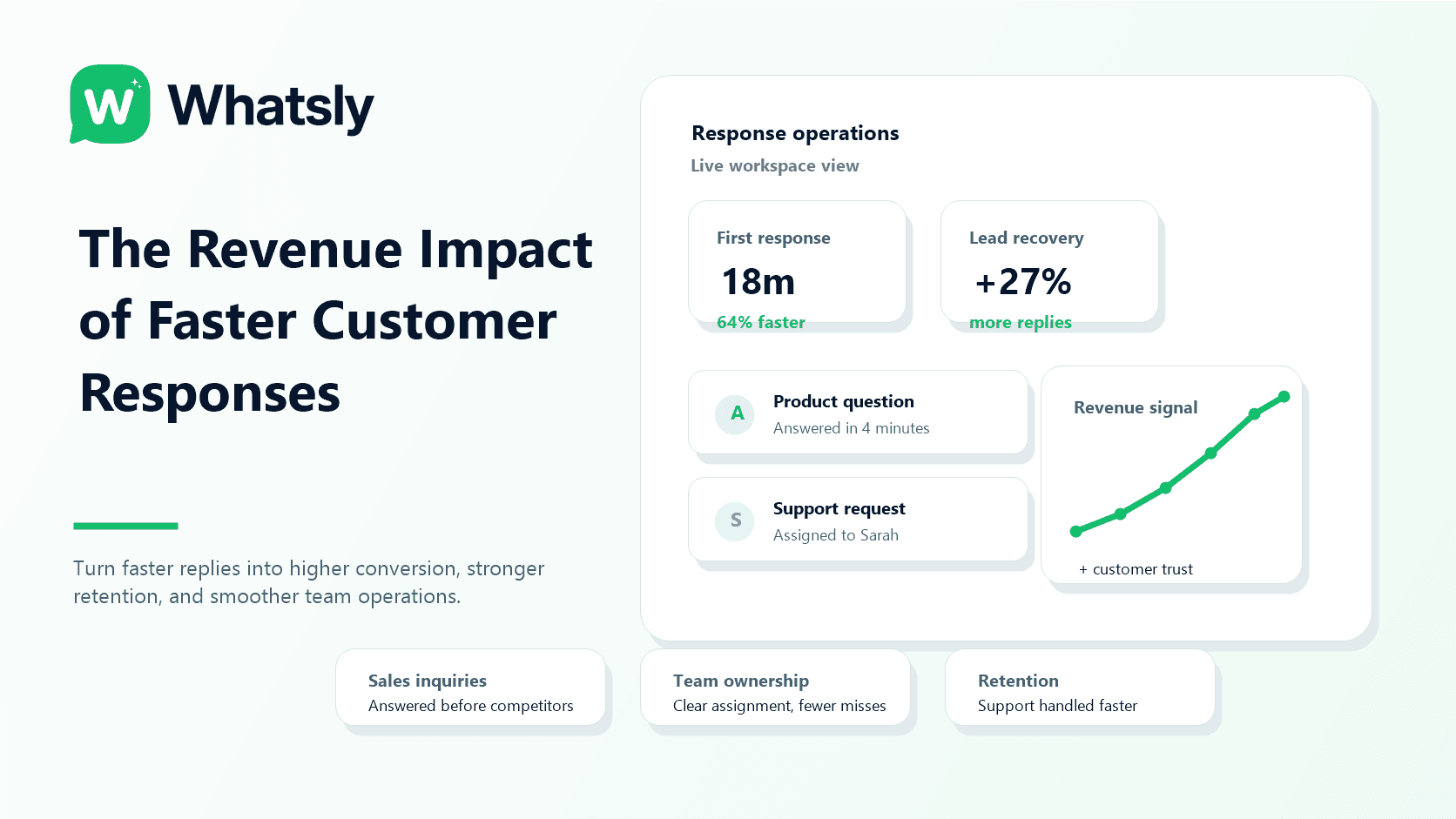
When businesses discuss growth strategies, they often focus on marketing campaigns, new products, or sales tactics.
Yet one of the most overlooked growth levers is customer response time.
Every customer interaction represents an opportunity. A sales inquiry could become a new customer. A support question could become a retention opportunity. A complaint handled well could become a positive review.
The challenge is that many businesses unintentionally create delays that damage customer relationships and reduce revenue potential.
Today, customer response speed has become a competitive advantage.
Why response time matters more than ever
Customer expectations have changed dramatically.
Consumers are accustomed to instant communication. Whether they are messaging friends, ordering food, or contacting businesses, they expect quick responses.
When businesses fail to respond promptly, customers often interpret silence as:
- Lack of professionalism.
- Poor customer service.
- Low reliability.
- Lack of interest.
Even if none of these assumptions are true, perception shapes decision-making.
The result is lost opportunities and declining customer trust.
The hidden cost of slow responses
Many organizations underestimate the financial impact of delayed communication.
Lost sales opportunities
Imagine a customer sends a WhatsApp message asking:
> Do you have this product in stock?
If the response arrives several hours later, the customer may have already purchased elsewhere.
In competitive markets, speed often influences buying decisions as much as price.
Lower customer retention
Existing customers expect efficient service.
When support requests sit unanswered, frustration increases. Repeated delays create dissatisfaction and increase the likelihood of churn.
Reduced team productivity
Without structured communication processes, teams often experience:
- Duplicate replies.
- Missed messages.
- Unclear ownership.
- Internal confusion.
The problem is not necessarily workload. It is frequently workflow.
Common causes of slow response times
Conversations are managed individually
Many businesses still rely on a single employee or phone to manage customer conversations.
As volume grows, this approach becomes unsustainable.
Lack of visibility
When multiple team members support customers, visibility becomes critical.
Without a centralized view of conversations, teams struggle to coordinate effectively.
No assignment process
Messages often remain unanswered because nobody knows who is responsible.
Ownership is one of the simplest ways to improve response speed.
Building a faster customer communication system
Improving response times requires operational improvements rather than simply increasing staffing levels.
Create clear ownership
Every customer conversation should have a designated owner.
This reduces confusion and ensures accountability.
Centralize customer conversations
When teams can access all customer interactions in one place, collaboration becomes significantly easier.
Customer history remains available, context is preserved, and handoffs become seamless.
Use internal collaboration tools
Support and sales teams frequently need input from colleagues.
Internal notes allow teams to collaborate without exposing internal discussions to customers.
Prioritize high-value conversations
Not every conversation carries the same urgency.
Businesses should establish systems that help teams identify:
- New leads.
- Escalations.
- High-value customers.
- Time-sensitive requests.
This ensures resources are allocated effectively.
Practical example
Consider two businesses receiving 100 customer inquiries daily.
Business A
- Messages managed individually.
- No conversation ownership.
- Limited customer history.
- Slow escalation process.
Average response time: 4 hours.
Business B
- Shared inbox.
- Assigned conversations.
- Customer profiles available.
- Internal collaboration workflows.
Average response time: 20 minutes.
Over time, Business B is likely to:
- Convert more leads.
- Retain more customers.
- Improve customer satisfaction.
- Increase operational efficiency.
The difference is not necessarily team size.
It is communication infrastructure.
Measuring what matters
Businesses should regularly track a few practical metrics.
First response time
How quickly does the team acknowledge a customer inquiry?
Resolution time
How long does it take to fully address the customer's need?
Customer satisfaction
Are customers happy with the support experience?
Team workload distribution
Are conversations being distributed effectively across team members?
Consistent measurement creates opportunities for continuous improvement.
Response time as a growth strategy
Customer communication is no longer just a support function.
It influences:
- Revenue generation.
- Customer retention.
- Brand reputation.
- Team efficiency.
- Customer lifetime value.
Organizations that treat communication as a strategic asset often outperform competitors that view it as an operational necessity.
Conclusion
Faster response times create better customer experiences, stronger relationships, and more revenue opportunities.
As customer expectations continue to rise, businesses need systems that help teams communicate efficiently, collaborate effectively, and maintain visibility across every conversation.
Platforms like Whatsly help businesses centralize customer conversations, improve team collaboration, and deliver the fast, consistent experiences customers expect.
Small improvements in response time can create significant improvements in business growth.